
Finding Gainesville Residents by Record
The best first source depends on whether you have a person, place, or year. The Alachua County Property Appraiser accepts an owner name or street address and makes a good present-day parcel check. A deed search then links named parties to a recorded transfer. For one person, court, voter, license, business, or vital-record indexes may corroborate an identity. For an older household, the Alachua County Library District's city and telephone directories are often more useful than a modern database.
No official roll is a full list of occupants. A tax owner may live elsewhere. A permit applicant may be a contractor, and a deed grantee may hold an investment parcel. Renters and people living with relatives may not appear in property records at all. Treat every result as evidence of a specific fact, not proof of every fact about a person.
- Search the county property roll by the known name or address, then save the parcel number and legal description.
- Check the Clerk's Official Records index for transfers, liens, satisfactions, and other recorded links.
- Use the appropriate voter, court, license, or business index to seek an independent match.
- For an older trail, consult Gainesville city directories, telephone books, newspapers, and census material.
- When online coverage ends, ask the custodian about counter inspection, scanned index books, mail copies, or a chapter 119 request.
Gainesville Resident Records Keepers
Gainesville is the Alachua County seat, so its main constitutional offices are close at hand. The Clerk combines court-clerk and recorder duties. The Property Appraiser maintains parcel and owner data, while the Supervisor of Elections controls local voter records. City offices separately keep permits, planning, code, board, and municipal records. The county constitutional-offices directory is a reliable starting point for current contacts.
Supervisor of Elections
515 N Main Street, Suite 300
Gainesville, FL 32601
352-374-5252
Office records also have different time spans. Current parcel data should not be used as a substitute for a deed image, and an online court result may omit an older paper file. Call before visiting to confirm the record series, date range, inspection method, and copy options.
Check the county's current office directory alongside the captured source below.
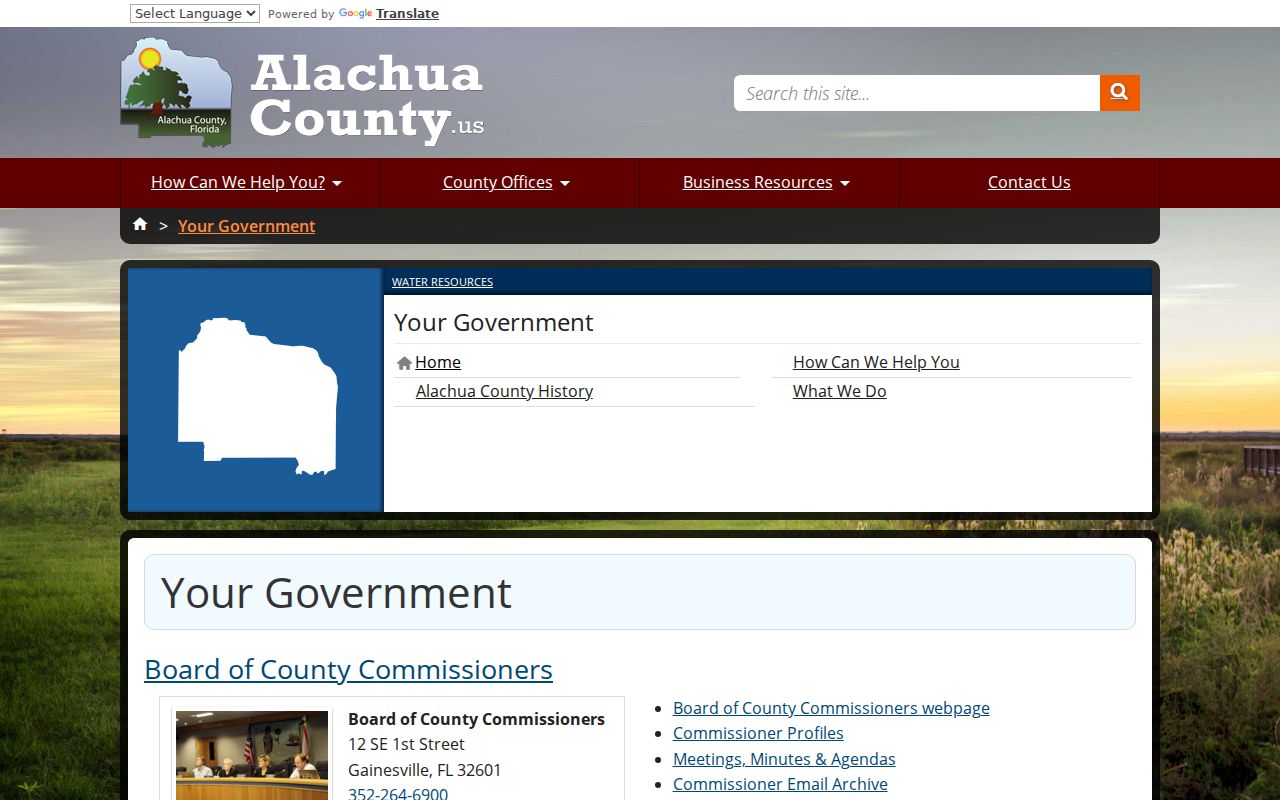
The county directory helps confirm which constitutional officer keeps each Gainesville record before a call or visit.
Search Gainesville Property Records
The Alachua County Property Appraiser offers property, sales, and comparison searches. A result can connect an owner name, mailing address, situs address, parcel number, legal description, sale history, land and building details, and exemptions. Situs means the physical location of the parcel. Mailing information may point somewhere else.
| Search field | Best use | Read with care |
|---|---|---|
| Owner name | Find parcels held by a named owner | Use last name first and test variants |
| Location address | Identify one current parcel | Keep the quadrant and street type |
| Parcel number | Carry the same property across systems | Best bridge to GIS and deeds |
| Subdivision or legal text | Resolve lots when an address changed | Compare plat, block, and lot |
The parcel ID and legal description are stronger connectors than a person's name alone. Use them in MapGenius and the deed index. The Gainesville directory by street gives the full address workflow without turning an owner listing into a claim of residence.
Open the official property-search source before viewing the captured interface below.
The screenshot marks the public starting point; confirm live fields and current values on the official portal.
Gainesville Deed Record Dates
The Clerk's online coverage changes as a search moves back. The computerized Official Records index begins in 1971, and free images are generally available from 1978. Separate scanned index books cover 1928 through 1971. Older Ancient Records have their own catalog and research path. That is why a failed modern search does not prove that a deed or named party is absent.
A grantor is the person who transfers an interest; a grantee receives it. Search both roles and note the instrument number, recording date, book and page, document type, legal description, and related references. The instrument number is often the safest way to request the exact image or certified copy.
- Roll
- An official list kept for a defined purpose, such as tax or voter administration.
- Index
- A finding aid that points to a document; it is not always the document image.
- Parcel
- A mapped unit of land identified by a county number and legal description.
- Criss-cross directory
- A volume arranged by street and address rather than only by surname.
Review the Clerk's public-record choices before using this captured page.
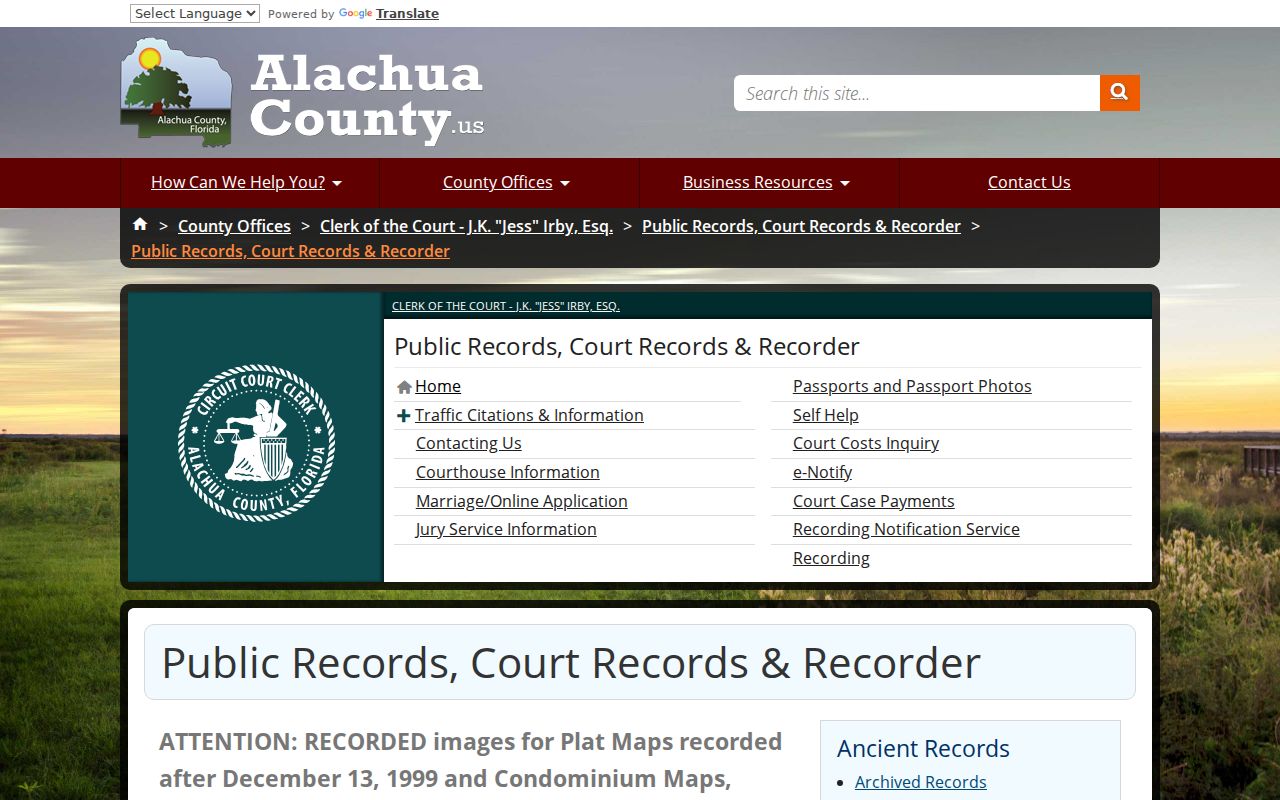
The separate links on the Clerk page matter because current records, historic indexes, plats, and court files do not share one search.
Current Gainesville Directory Sources
Today's Gainesville residents directory is a group of limited-purpose records. Each source lists people because of a parcel, filing, registration, license, case, or civic role. None is a master household list. Pick the row that matches the fact you need, then confirm the result with another keeper.
| Official source | Named people | Custodian | Channel |
|---|---|---|---|
| Property roll | Parcel owners and mailing recipients | Property Appraiser | Free portal, phone, or office |
| Official Records | Parties to deeds, liens, judgments, and notices | County Clerk | Online index, scanned books, counter, copies |
| Voter records | Registered voters, subject to exclusions | Elections offices | Personal status lookup or lawful extract request |
| Citizenserve | Applicants, contractors, and contacts on city cases | City divisions | Public portal, phone, counter, records request |
| State licenses and entities | Licensees, officers, agents, and filing contacts | DBPR, MQA, Division of Corporations | Free state indexes |
Use a careful Gainesville resident search workflow when a common name needs verification across sources. It keeps a court party, parcel owner, business officer, and license holder from being merged merely because their names resemble one another.
Gainesville Voter Record Limits
Florida treats much voter-registration information as public under section 97.0585, Florida Statutes. Social Security numbers, driver-license or state-identification numbers, the source of an application, and signatures receive protection. Address Confidentiality Program participants and qualifying high-risk professionals can have additional safeguards.
The county's My Registration Status form is designed for a person to check an individual registration with identifying inputs. A broader statewide voter extract follows a separate request channel and keeps statutory exclusions redacted. Those are different tools. Do not treat a failed self-lookup as a street roster.
Use resident records only for lawful personal research. Never use an address or name to stalk, harass, threaten, or harm anyone.
Note: A voter record can show registration evidence, but it does not establish every member of a Gainesville household.
Gainesville City Address Records
Gainesville's Citizenserve portal links building permits, planning and zoning matters, inspections, and Neighborhood Enhancement or code cases to an address or parcel. Search modes may include a record number, address, parcel, record type, and status, depending on the module. Results commonly show a record number, location, description, status, dates, contacts or contractors, inspections, and attachments.
This evidence describes activity at a place. It does not by itself name an occupant. For missing legacy records or fields, contact the relevant city division, inspect at the counter, or use the city public-record request channel. Florida law does not require a requester to explain a purpose or use a special form, though a clear written scope creates a useful date trail.
Gainesville Court Record Checks
The Alachua County Clerk provides court-search instructions for local Circuit and County Court cases. Search by party name, case number, or date when the portal allows it. A useful result may include the case number, style, court type, filing date, party role, docket entries, and disposition. A docket is the chronological list of filings and court activity. It is not the same as reading every filed document.
Online access has firm gaps. The oldest listed case dates to July 23, 1928, but many closed civil files before 1999, criminal files before 1990, and traffic files before March 2006 need courthouse research. The web system also uses a CAPTCHA, has a 30-minute idle timeout, and limits retrieval to 60 documents per hour. Ask the Clerk about inspection or copies when an older result lacks an image.
Federal cases use PACER, and Florida appellate matters use ACIS. Keep each court level separate. Matching names in two systems do not prove one identity without another shared fact.
Gainesville Vital Record Paths
The Florida Department of Health in Alachua County issues Florida birth certificates from 1917 forward and local death certificates. The state Bureau of Vital Statistics handles Florida birth, death, marriage, and divorce certifications. The Clerk separately keeps local marriage licenses and divorce case files, which may contain different detail than a state certification.
Birth records less than 125 years old are confidential under chapter 382. Death certificates without cause are public, while cause-of-death information remains confidential for 50 years under sections 382.008 and 382.025. Marriage and divorce reports are public. Eligibility, identification, fees, mail, walk-in, and authorized online channels depend on the certificate type, so use the current state form rather than assuming one rule fits all.
When Gainesville Portals End
Online failure should trigger a change of channel. Call the keeper and ask for the formal series name, date span, and whether the material is indexed, imaged, microfilmed, or paper only. Counter inspection may expose material that the public portal does not. A focused mail or email request can then cite a person, property, date range, and document type.
Florida Public Records Law, chapter 119, implements article I, section 24 of the Florida Constitution. Inspection must be available at a reasonable time, subject to lawful exemptions. Agencies may charge statutory duplication costs and a reasonable special-service charge for extensive clerical or information-technology work. Ask for an estimate before authorizing a broad search.
| If the web search fails | Next Gainesville channel |
|---|---|
| Deed or recorded instrument | Scanned 1928-1971 books, Ancient Records, Clerk counter, mail copy request |
| Older court file | Clerk courthouse research and copy request |
| City permit or code record | Responsible division, city counter, chapter 119 request |
| Historic household | ACLD reference desk, microfilm, Matheson, UF collections |
Official Gainesville Directory Sources Compared
Official sources are narrow but accountable. A custodian defines the field, corrects the source record, and can provide a certified copy when available. Commercial people-finder tools combine data from many places, often without showing which record produced a claim. Their speed does not cure stale addresses, merged identities, or missing context.
| Choice | Strength | Limit |
|---|---|---|
| Official public index | Clear keeper and record purpose | May cover only one time span or event |
| Certified official copy | Custodian authentication | May require eligibility, payment, or waiting |
| Commercial compilation | Fast cross-source hints | Can be stale, merged, incomplete, or poorly sourced |
When a name matters, return to the office that created the record. Corrections belong with that custodian, not with a later compiler.
A certified copy serves a different purpose from a screen result. The Clerk can certify eligible recorded or court documents, while vital-record certifications come from the health department or state bureau. Save the index citation first, then ask the correct keeper about identity requirements, format, cost, and delivery. That short check prevents paying for the wrong file.
Gainesville Unclaimed Property Records
Florida Treasure Hunt adds a useful statewide name search. It lists unclaimed property held for owners, and a claimant must provide proof before funds or property are released. A matching entry is a lead, not current-address proof. Compare the holder and any displayed location with other records before deciding that two similar names belong to one person.
Open Florida Treasure Hunt to compare its live search with the captured source below.
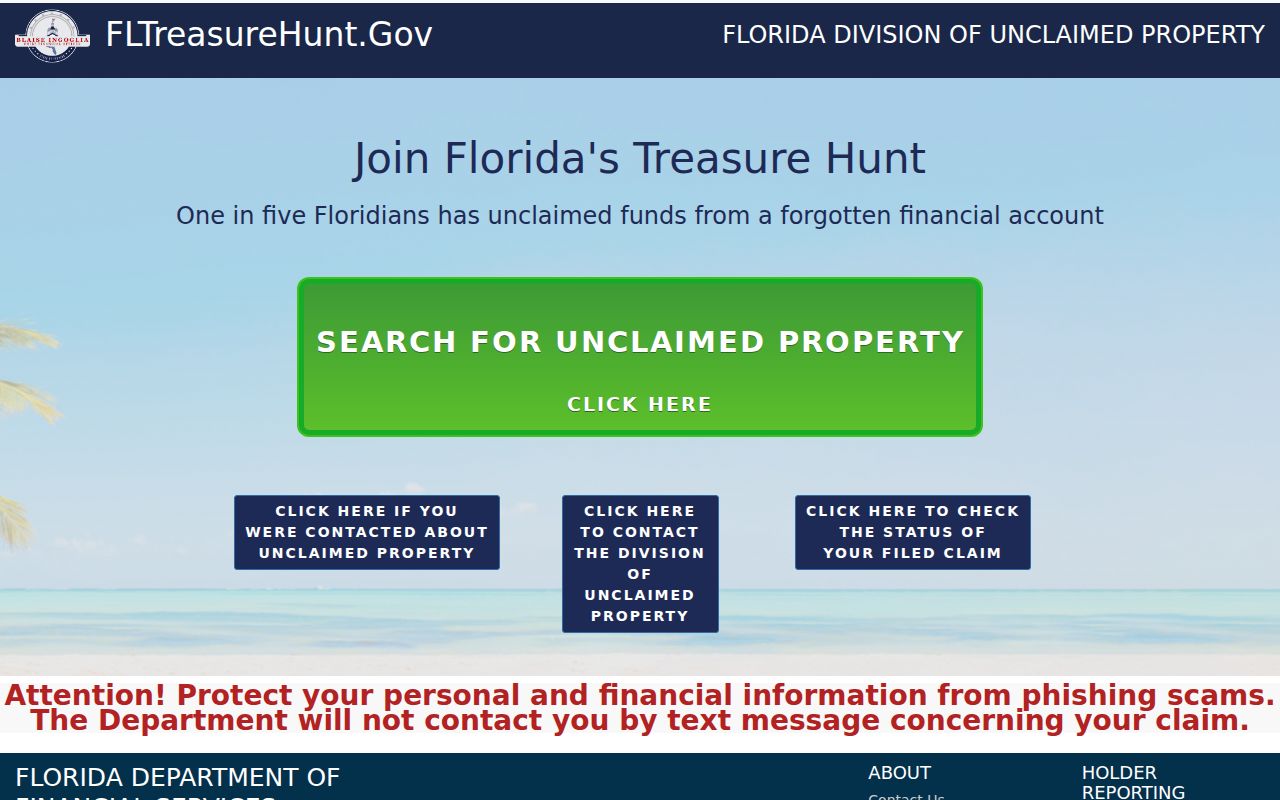
The interface provides a free starting point; the state claim process, not the name result alone, tests ownership.
A state report issued April 16, 2026 said $92 million was returned during March, including $1 million in the Gainesville region. Read the Gainesville-region announcement and then view its captured page.
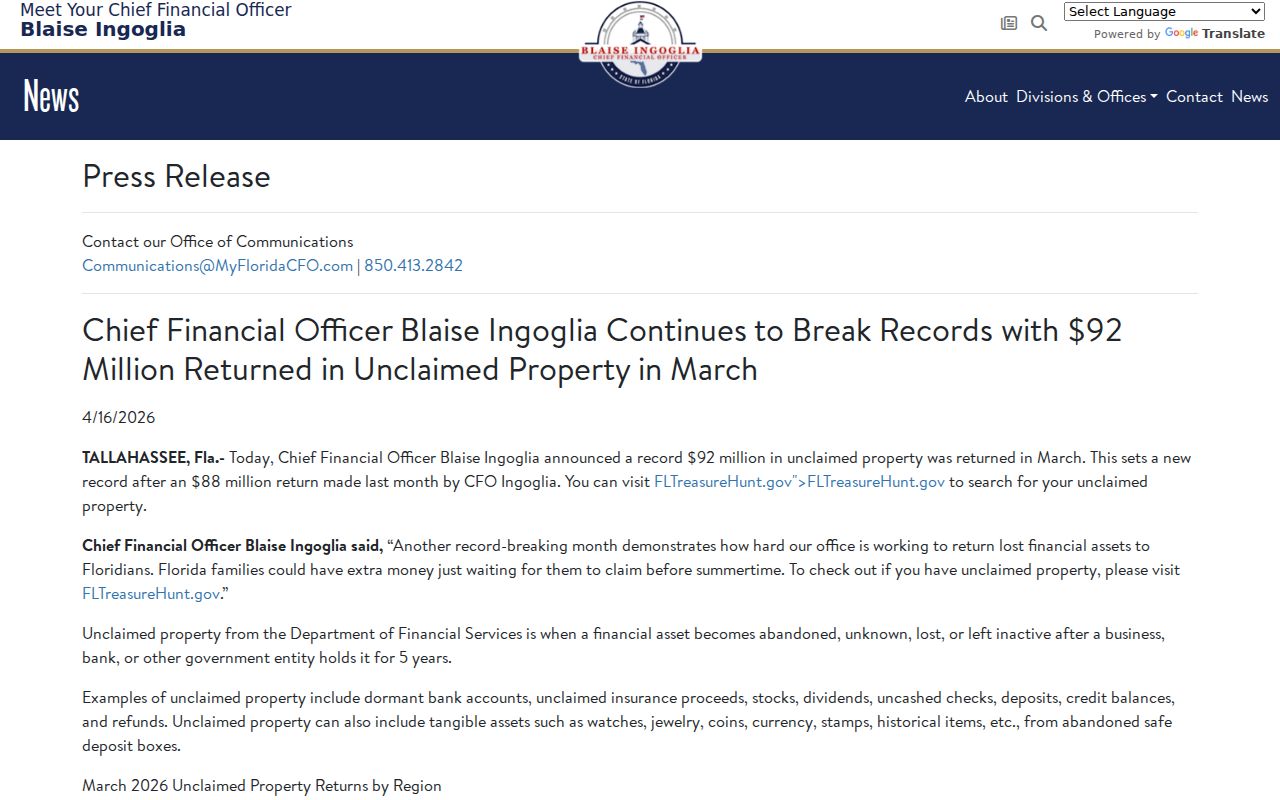
The reported total shows why a careful name search can have a practical use, while still requiring proof through the official claim channel.
Historical Gainesville Resident Directories
The Alachua County Library District Headquarters holds Gainesville's most useful directory shelf. Its runs include the Coy directory for 1934-35, Polk and Miller volumes from 1938 with missing years, telephone directories spanning 1907-2011, and Hill-Donnelly reverse directories from 1969 with gaps. The reverse books arrange entries by street, making an old address as useful as a surname.
The Gainesville Sun extends the trail through notices, obituaries, advertisements, and community news. Library microfilm reaches back to 1865 with gaps and continues through 2018; the searchable digital collection covers 1911 to the present. HeritageQuest adds census, Freedman's Bank, pension, genealogy-book, and serial-set material. Physical reference items may be available for in-library use, and staff can explain branch transfer or microform options.
Use a directory entry only for what it states. Abbreviations may name a spouse, occupation, employer, or address, while later reverse volumes reveal nearby households. Missing years and omitted residents mean absence is not proof of a move. The full shelf-by-shelf method belongs in the Gainesville historical city directories.
Gainesville became the county seat in 1853, and its first courthouse followed in 1856. That long civic role helps explain why county, city, library, museum, and university sources overlap here. A good historical search shifts among them instead of expecting one uninterrupted index.